PRESS & MEDIA
“The Home Office is everyone”: Immigration Raids in Birmingham under Labour
Freedom of Information data on immigration enforcement operations in Birmingham between April 2023 and December 2025 reveal a sharp intensification of enforcement activity over the past year. Two separate FOI requests submitted by researchers at the Institute for Research into International Migration and Superdiversity at the University of Birmingham help reconstruct this trajectory. The first (FOI 07429) covers enforcement activity between April 2023 and March 2025 and provides quarterly data on visits, arrests and removals, including postcode-level data for visits. The second (FOI 01952) covers January to December 2025 and includes postcode-level data on enforcement visits and the nationalities of those arrested.
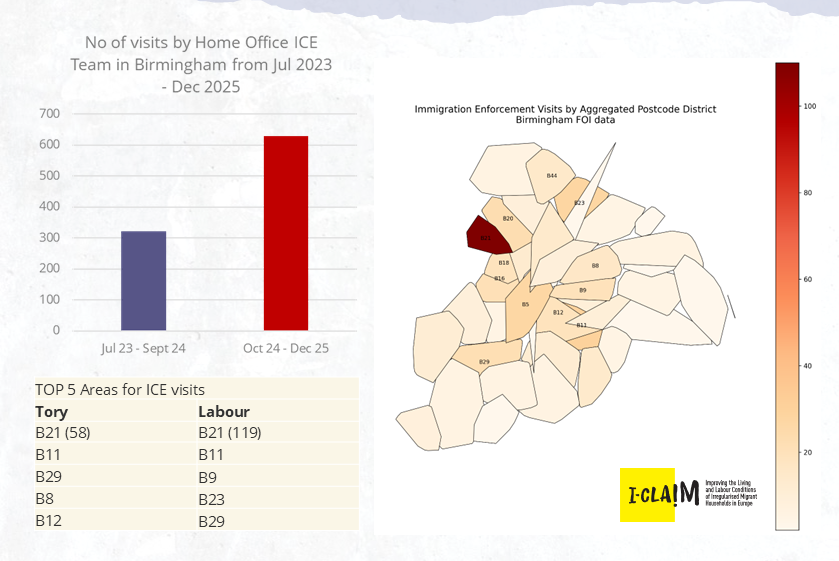
The data indicate a clear escalation following the change of UK government in July 2024. In the fifteen months prior to the Labour government taking office there were at least 321 enforcement visits. In the following fifteen months there were at least 630 visits, suggesting that immigration raids in Birmingham have roughly doubled in frequency. The increase becomes even more pronounced in the second half of 2025, broadly coinciding with Shabana Mahmood becoming Home Secretary. The last six months covered by FOI alone account for nearly 300 raids.
While enforcement activity has intensified, roughly only half of enforcement visits lead to no arrest at all, and only around one in ten arrests ultimately results in a removal from the UK. If the purpose of these operations is to identify and remove people without legal status, the data suggest that most raids do not achieve that outcome.
Where the raids take place
The postcode-level data also reveal a highly concentrated geography of enforcement. A relatively small number of districts consistently account for a large share of raids, including B21 (Handsworth), B11 (Sparkbrook/Sparkhill), B8 (Alum Rock) and B29 (Selly Oak).
At the same time, the data show some shifts during the Labour period, with additional hotspots emerging in B9 (Small Heath) and B23 (Erdington). In the 2025 dataset alone, more than 524 visits were recorded across Birmingham. B21 accounted for around 110 raids, followed by B11 (30 visits), B23 (28), B5 (27), B20 (23) and B29 (22). Together, these six districts account for roughly 45% of all recorded raids.
These areas include inner-city and inner-ring districts with dense small-business economies, relatively affordable housing and significant migrant populations. Major commercial corridors such as Soho Road, Alum Rock Road, Stratford Road and Coventry Road host clusters of restaurants, retail shops and service-sector workplaces where migrant labour is common. As a result, immigration enforcement appears closely aligned with the geography of precarious work, concentrating raids in areas where sectors such as hospitality, retail, logistics and delivery work rely heavily on migrant labour.
Raids, arrests and deportations
The FOI data also provide insight into what happens during these raids. Between June 2023 and May 2025, Immigration Compliance and Enforcement teams reported at least 644 arrests in Birmingham. Arrests broadly follow the increase in enforcement activity, rising from 31 arrests in 2023 Q2 to a peak of 120 arrests in 2025 Q1.
Yet the number of individuals actually removed from the UK remains low. Over the same period around 60 individuals were deported, meaning that roughly nine out of ten people arrested during raids were not subsequently removed.
Another notable trend concerns visits that produce no enforcement outcome. Across the period covered by the first FOI, ICE teams recorded 384 visits where no enforcement action was taken.
Overall, these figures suggest that the main effect of the recent enforcement surge has been the visible expansion of immigration policing rather than a substantial increase in removals.
Nationalities targeted
The nationality breakdown of arrests in 2025 shows a strong concentration among a small number of groups. Indian nationals account for the largest share of arrests, followed by Pakistani nationals, with smaller numbers involving individuals from countries such as China, Afghanistan, Romania, Iran, Albania and Ghana.
Yet even among the largest groups, relatively few arrests translate into deportations. Of the 205 Indian nationals and 71 Pakistani nationals arrested, only 20 Indians and 7 Pakistanis were subsequently removed.
Effects on migrant workers
Even when raids lead to no arrests, they still have significant consequences for local communities and migrant workers. Our research with migrant workers in Birmingham shows that frequent enforcement activity creates an atmosphere of fear that discourages people from reporting labour exploitation, crime or unsafe working conditions.
Food delivery riders are particularly exposed because their work takes place largely in public space. At the same time, delivery platforms increasingly carry out identity and labour verification through their apps, including account checks, facial recognition and location monitoring.
This combination can push workers to accept longer hours, lower pay and more precarious arrangements while discouraging them from reporting abuse or violence.
Ibrahim wears a balaclava when he rides his bike. There is no purpose in reporting abuses to the police or the app, he explains. He can’t trust anyone: “The Home Office is everyone”, he says during a fleeting conversation outside a gathering point for delivery riders in Birmingham.
The intensification of immigration enforcement therefore extends well beyond formal raids. It shapes the everyday conditions under which migrant workers live and work, reinforcing insecurity both inside and outside the workplace.